

SENIOR HEALTH

Health Checkup After 40 in Chennai: Which Tests Are Worth Doing, and the Fasting Rules

In short

After 40, the list of tests with proven screening value is shorter than most packages suggest. India's national programme screens adults from 30 for blood pressure and diabetes once a year, and for oral, breast and cervical cancer.

Published 16 August 202615 min read
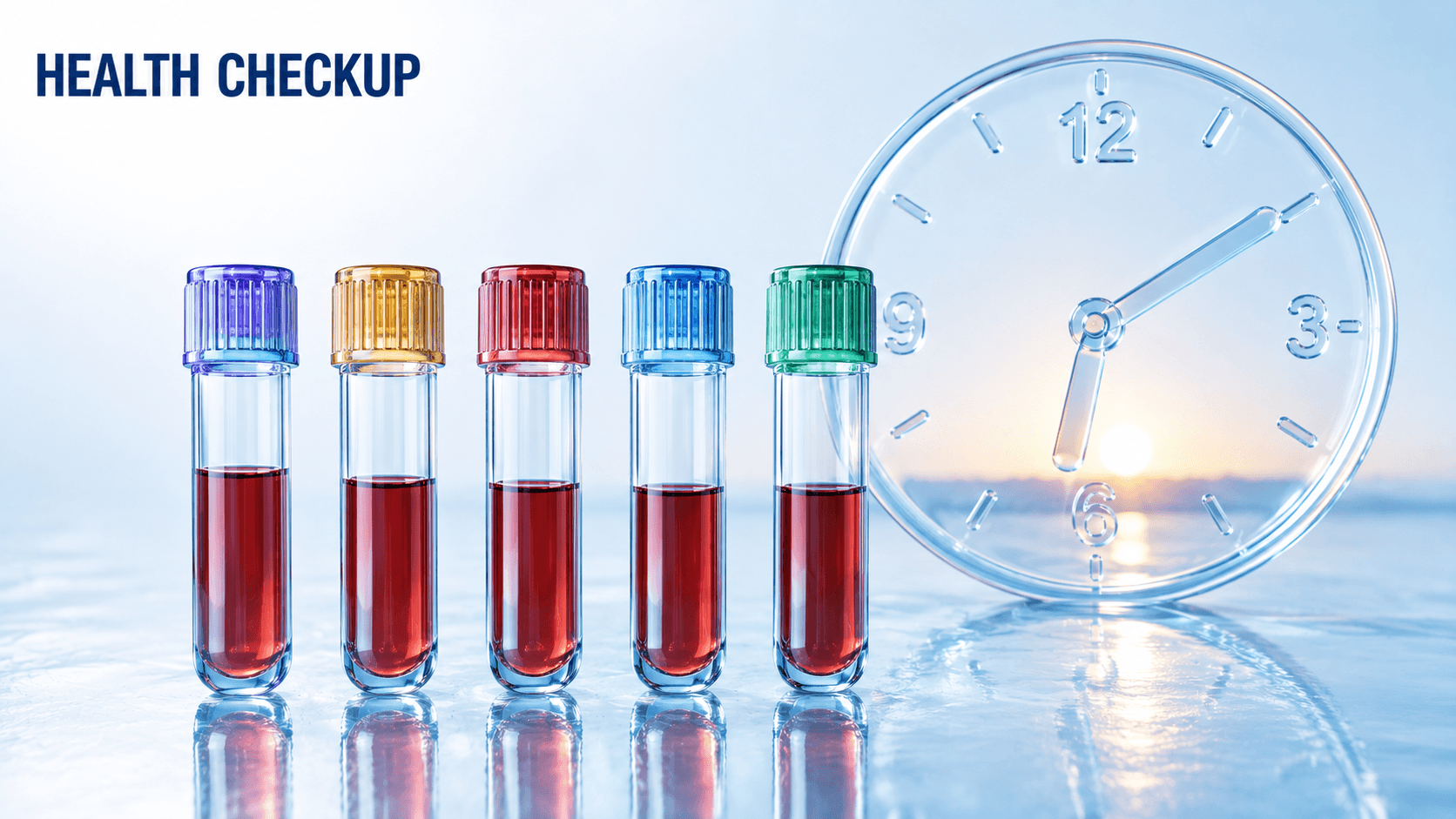
Glass blood-collection tubes in a row before an early-morning clock face, illustrating the fasting tests in a health checkup after 40
Dr. Ashutosh Kumar Singh

Medically reviewed

Dr. Ashutosh Kumar Singh

Consultant · General Physician & Emergency Medicine · MD, MEM, FICM, PGCR, CAM (UK), MRCEM · TNMC 126451

After 40, the list of tests with proven screening value is short. India's national programme screens adults aged 30 and above for blood pressure and diabetes once a year, and women and men aged 30 to 65 for oral, breast and cervical cancer once in five years (NP-NCD Training Module for Medical Officers, NHSRC/MoHFW, 2021). ICMR puts the starting age for diabetes screening at over 30, not 40 (ICMR Guidelines for Management of Type 2 Diabetes 2018, Section 2.1).

This page publishes the test list, the repeat interval and the fasting rule for each, and names the items that are commonly sold in a checkup panel but have no established screening value in a person with no symptoms. There is no package described here and no cost information anywhere on the page, because a package is a commercial object and a screening interval is a clinical one, and they are not the same thing.

One thing before the list. A health checkup is for a person who feels well. It is not the route for a symptom. AJSMC is an outpatient and day-care centre in Egmore, Chennai, open Monday to Saturday, 10am to 9pm, with no casualty unit, no emergency department, no inpatient beds and no intensive care. Chest pain, sudden breathlessness, weakness down one side, slurred speech, fainting, or a severe headache of sudden onset is not a checkup question at all — call 108 or go straight to the nearest hospital with a 24-hour emergency department, at any hour, including when we are closed.

Which tests are actually worth doing after 40 in Chennai?

The ones below, because an Indian national body has named the population, the test and the interval. Everything else is a decision a doctor makes from your history and examination, not an item bought off a list. Note that the first item in the table is not a laboratory test at all, a blood pressure reading, like a body-weight and waist measurement, needs no fast and no needle.

TestWho, per Indian guidanceInterval if normalFasting neededSource (year)
Blood pressureAll adults 30 and aboveOnce a yearNoNP-NCD population-based screening, MoHFW/NHSRC (2021)
Blood glucose — fasting plasma glucose, OGTT or random plasma glucoseAll adults over 30; earlier if any risk factor is present3 years if normal; 1 year if prediabetes8 hours for a fasting sample; 8–10 hours plus 3 days of at least 200 g carbohydrate a day for an OGTT; none for a random sampleICMR Guidelines for Management of Type 2 Diabetes 2018, Sections 2.1, 2.4 and 3.4
HbA1cAccepted by ICMR for screening, with stated Indian limitationsAs aboveNoICMR 2018, Section 2.2
Lipid profilePart of cardiovascular risk factor assessment alongside glucose screeningNot fixed by ICMR 2018 — the doctor sets it from your riskNot routinely; a non-fasting sample is recommendedICMR 2018, Section 2.5; EAS/EFLM joint consensus, European Heart Journal 2016;37:1944–1958
Oral cancer — visual examination of the mouthMen and women 30–65Once in 5 yearsNoNP-NCD Training Module for Medical Officers (2021)
Breast cancer — clinical breast examinationWomen 30–65Once in 5 yearsNoNP-NCD Training Module for Medical Officers (2021)
Cervical cancer — visual inspection with acetic acid (India); HPV DNA test (WHO)Women 30–65Once in 5 years under the Indian programme; every 5 to 10 years from age 30 in WHO's guidelineNoNP-NCD Training Module for Medical Officers (2021); WHO guideline for screening and treatment of cervical pre-cancer (2021)

Two honest caveats belong with that table. ICMR itself records that HbA1c "is also recommended for screening; however, in India there are some limitations regarding its use" (ICMR 2018, Section 2.2), so it is a convenient test, not automatically the right one for every patient in Chennai. And ICMR 2018 does not fix a repeat interval for the lipid profile the way it does for glucose, so anyone quoting you a firm lipid interval is quoting something other than ICMR.

Why does Indian guidance start at 30, not 40?

Because type 2 diabetes appears earlier in Indians. ICMR states that it occurs "at least a decade earlier" in Indians than in other major ethnic groups, and sets screening for all individuals over 30 years of age (ICMR 2018, Section 2, p.7). The American standard, for comparison, begins universal screening at 35 and repeats at a minimum of 3-year intervals if normal (ADA Standards of Care in Diabetes—2026). India's own body sets the bar five years earlier than the American one. If you are reading this at 42 in Chennai and have never had a sugar checked, you are twelve years past the Indian threshold, not two.

ICMR also lists the conditions under which screening should start earlier than 30. Any one of them is enough.

Screen earlier than 30 ifThe threshold ICMR gives
Family history of diabetesAny
Overweight or central obesityBMI 23 kg/m² or above, or waist above 90 cm in men and above 80 cm in women
Raised blood pressure130/80 mmHg or above, or already on treatment
DyslipidaemiaAny
Sedentary activity levelAny
Past gestational diabetes or a large babyBirth weight above 3.5 kg
Past ischaemic heart disease or cerebrovascular diseaseAny
PCOS or acanthosis nigricansAny

Source: ICMR Guidelines for Management of Type 2 Diabetes 2018, Section 2.1, p.7. Note the BMI figure — 23 kg/m², not 25. A person who has been told all their adult life that they are not overweight can still meet this criterion on the Indian cut-off.

The national numbers explain why the interval matters more than the panel size. In the ICMR-INDIAB-17 survey of 113,043 people, published in Lancet Diabetes & Endocrinology in 2023, about one adult in six or seven had prediabetes, a group defined entirely by a blood test, because it has no symptoms at all.

National prevalence, Indian adultsFigure
Diabetes11.4% (95% CI 10.2–12.5)
Prediabetes15.3% (13.9–16.6)
Hypertension35.5%
Generalised obesity28.6%
Abdominal obesity39.5%
Dyslipidaemia81.2%
Participants and survey period113,043 surveyed, 18 October 2008 to 17 December 2020

Source: Anjana RM et al., ICMR-INDIAB-17, Lancet Diabetes & Endocrinology 2023;11:474–489. These are national figures. State-level breakdowns for Tamil Nadu circulate widely online in forms that could not be verified against the published paper, so this page does not print one.

How long do I fast before a blood test, and can I drink water?

The fast belongs to the test, not to the visit. Only two of the tests on this page need one at all, and an overnight fast taken for any of the others serves no purpose. Fasting is defined by the American Diabetes Association as no caloric intake for at least 8 hours (ADA Standards of Care in Diabetes—2026) — plain water carries no calories, so water does not break it.

TestHow long to fastPlain waterWhat breaks the fastSource (year)
Fasting plasma glucoseAt least 8 hours with no caloric intakeAllowedTea or coffee with milk or sugar, juice, a biscuit, chewing gum, any foodADA Standards of Care in Diabetes—2026
Oral glucose tolerance testOvernight fast of 8–10 hours, and a normal diet with at least 200 g of carbohydrate a day for at least 3 days beforehandAllowed before the test; the glucose drink is part of the test itselfAny food or the fasting rule above; also eating or smoking between the two samples, and a low-carbohydrate diet in the days before, which can distort the resultICMR 2018, Section 3.4
HbA1cNo fast at allAllowedNothing — eat normallyADA Standards of Care in Diabetes—2026
Lipid profileNot routinely requiredAllowedNothing routinely. A fasting repeat is advised only if the non-fasting triglycerides exceed 440 mg/dL, or in known high triglyceridesNordestgaard BG, Langlois MR et al., EAS/EFLM joint consensus, European Heart Journal 2016;37:1944–1958
Random plasma glucoseNone, by definitionAllowedNothingICMR 2018, Section 3.1
Blood pressure, weight, waist, oral, breast and cervical screeningNoneAllowedNothingNP-NCD Training Module for Medical Officers (2021)

The single most useful correction here is the lipid row. The joint European Atherosclerosis Society and European Federation of Clinical Chemistry consensus concluded in 2016 that non-fasting samples should be used routinely for a lipid profile, with a fasting repeat only in the narrow circumstances above. A cholesterol test on its own is therefore not a reason to skip breakfast.

One safety point on fasting that applies to a specific group. If you already take medicine that lowers blood glucose, do not decide on your own to fast before a checkup — ask the doctor first, because an unnecessary fast on glucose-lowering treatment carries a risk of hypoglycaemia. Which test you actually need, and whether it requires a fast, is a question to settle before the morning of the visit rather than at the counter.


Which commonly sold panel items have little screening value?

Several. The table below is not a claim that these tests are useless. Each has a proper use in a person with symptoms, or with a specific reason to be investigated. It is a narrower claim: in an adult with no symptoms, these have not been shown to be worth doing as routine screening. The grades are from the United States Preventive Services Task Force, cited here as evidence about the test rather than as Indian guidance; the Indian national programme, which is the primary frame throughout this page, does not include any of them either.

Panel itemWhat the evidence says for an asymptomatic adultGrade and year
CA-125 and/or transvaginal ultrasound for ovarian cancerDoes not reduce ovarian cancer mortality, and causes false positives that lead to unnecessary surgeryUSPSTF grade D — recommends against (2018)
Resting or treadmill ECG in a low-risk adultRecommended against for preventing cardiovascular eventsUSPSTF grade D (2018)
Resting or treadmill ECG at intermediate or high riskEvidence insufficient to weigh benefit against harmUSPSTF grade I (2018)
Thyroid function test in a non-pregnant asymptomatic adultEvidence insufficient to weigh benefit against harmUSPSTF grade I (2015)
Vitamin D level in an asymptomatic adultEvidence insufficient to weigh benefit against harmUSPSTF grade I (2021)
PSA, men aged 55–69An individual decision to be discussed, not an automatic inclusion in a panelUSPSTF grade C (2018)
PSA, men aged 70 and aboveRecommended againstUSPSTF grade D (2018)

The PSA rows deserve the full nuance rather than a yes or a no. Below 55 it is not a screening test in this framework at all; between 55 and 69 it is a conversation to have with a doctor about what a raised result would then lead to; from 70 it is recommended against. A test that is sold as a tick-box on a form has skipped the conversation that is the whole point of it.

Does a "full body checkup" package find things earlier?

Not in the way it is usually sold. The 2019 Cochrane review of general health checks in adults found that general health checks have little or no effect on all-cause mortality, cancer mortality or cardiovascular mortality — while increasing the number of new diagnoses (Krogsbøll LT et al., Cochrane Database of Systematic Reviews 2019, CD009009.pub3).

Read that carefully, because it cuts both ways. Cochrane tested the undifferentiated general checkup, a broad panel offered to everybody. It did not test named, interval-based screening for named conditions, which is exactly what the Indian national programme does recommend and what the first table on this page sets out. The defensible position is that a blood pressure reading every year and a glucose test at the interval ICMR specifies are worth doing, and that adding thirty more analytes around them mostly adds results that need explaining rather than answers that change anything.

The practical consequence for a patient in Chennai: ask what each line on a report is for and what would be done differently if it came back abnormal. If nothing would be done differently, the test was not screening you. It was measuring you.

Which cancer screening does India's programme cover after 40?

Three cancers, all of them screened once in five years in the 30 to 65 age band: oral cavity by visual examination, breast by clinical breast examination, and cervix by visual inspection with acetic acid (NP-NCD Training Module for Medical Officers, MoHFW/NHSRC, 2021). Those who screen negative in the first round are re-screened at the five-year interval. This is the whole of what population-based cancer screening covers in India, the 2016 Operational Framework for Management of Common Cancers names oral, breast and cervical cancer as the three that constitute a public health priority.

Two things follow from that. First, there is no national colorectal cancer screening programme in India, so a colonoscopy or a stool-based test is not a standard over-40 checkup item here; it is a test done for a reason, such as symptoms or a family history, and that reason is a discussion with a doctor. Second, WHO's 2021 guideline recommends HPV DNA detection as the primary cervical screening test from age 30, while India's programme still runs on visual inspection at community level. Both positions are current, and which applies to you is worth asking about rather than assuming. Cervical screening has its own preparation rules and its own timing, and they are covered separately in the AJSMC article on that test.

What can AJSMC do with this list, and what is a referral?

AJSMC is a multi-specialty outpatient and day-care centre at Police Commissioner Office Road, Egmore, Chennai 600008, with 28 consultants across 12 departments, an in-house laboratory handling blood, urine, biopsies and routine screening, and a pharmacy on site. Outpatient consultations run Monday to Saturday, 10am to 9pm. Phone 044 2532 2021.

Before travelling for any test named on this page, call 044 2532 2021 and ask which of them are run in the in-house laboratory and which are sent to a referral laboratory. That question is worth thirty seconds because it decides whether a fasting sample given in the morning is being handled the way you assumed.

A dilated retinal examination, the eye examination used to look for diabetic retinopathy, is arranged with the ophthalmology department; call 044 2532 2021 to ask what that visit involves and how it is booked.

Be equally clear about what is not here. There is no cardiologist on the AJSMC roster, so an ECG interpretation, a treadmill test or a cardiology opinion is a referral to a cardiologist elsewhere, not a service on this page, which matters less than it sounds, given that routine ECG screening in an asymptomatic adult carries a USPSTF grade D in the first place. And AJSMC has no emergency department, no beds and no intensive care, and is closed on Sundays and outside 10am to 9pm, a checkup is an appointment for a well person during working hours, and nothing on this page is a route for an illness that is getting worse tonight.

What should you bring?

Three things, and none of them is a form. Bring the actual strips or boxes of every medicine you take, including for blood pressure and cholesterol, rather than a list written from memory, the strength printed on the strip is the fact that matters. Bring your previous reports, because a screening number read against your own value from three years ago says considerably more than the same number read against a reference range. And bring the dates: when your blood pressure was last checked, when a sugar was last done, and when you last had any of the three cancer screenings above. Those dates decide what is actually due, which is the question this whole page exists to answer.

When should you see a doctor?

Book a consultation, not a panel, if you are over 30 and have never had a blood pressure and a blood glucose recorded, if either was abnormal at any point in the past, or if any of the ICMR risk factors in the second table applies to you. If your last normal glucose was three or more years ago, or one or more years ago after a prediabetes result, that test is due now (ICMR 2018, Section 2.4).

See a doctor promptly, rather than waiting for a scheduled checkup, for anything that is a symptom rather than a number: unexplained weight loss, a mouth ulcer or white or red patch that has not healed in three weeks, a breast lump or nipple discharge, bleeding between periods or after intercourse or after menopause, blood in the stool or urine, a persistent cough, or unusual tiredness with excessive thirst and passing large volumes of urine. A screening interval is designed for people without symptoms, and a symptom overrides it.

Go to a hospital with a 24-hour emergency department, or call 108, and do not wait for an outpatient appointment, for chest pain or pressure, sudden breathlessness, weakness or numbness on one side of the body, difficulty speaking, a sudden severe headache, fainting, or vomiting with drowsiness or confusion. AJSMC has no casualty unit and is closed outside Monday to Saturday, 10am to 9pm, and the correct destination for any of these is a hospital that is open around the clock.

This article is for general information and is not a substitute for a consultation. AJSMC does not run a casualty or trauma unit — in a life-threatening emergency call 108 or go directly to the nearest hospital with a 24-hour emergency department. For appointments and questions our helpline is answered 24 hours on 044 2532 2021.

Talk to a doctor

Still not sure what applies to you?

An article can tell you what usually happens. It cannot examine you. Bring your reports to a consultant at AJSMC in Egmore and get an answer about your own case.

FAQ

Questions people ask after reading this

Come early in the outpatient hours, which start at 10am, so the fast is not longer than it needs to be. Call 044 2532 2021 the day before to confirm which of your tests need one.

Related reading